
Figma's 2026 AI report: Can AI help us collaborate better?




AI used to be a solo act. According to our research, it’s not anymore.
Share Figma's 2026 AI report: Can AI help us collaborate better?
Illustrations by Zoé Maghamès Peters
Figma’s 2026 AI report draws from three years of data, including 8,403 total survey responses and 639 qualitative interviews from designers, developers, and product managers. This year, we expanded coverage from seven markets to ten, adding Brazil, India, and South Korea to samples in the United States, United Kingdom, Japan, Germany, France, Canada, and Australia.
We’ve all heard of the 10x engineer: the fabled hero whose output sets them above the rest. But when AI can 10x anyone, personal productivity stops being the thing to optimize for. Now, for the first time in our three years of data, AI meaningfully changes how teams work together: 41% of respondents say so today, compared to only 7% two years ago.


Read Figma's 2026 AI report to learn more about how AI is changing collaboration and design.
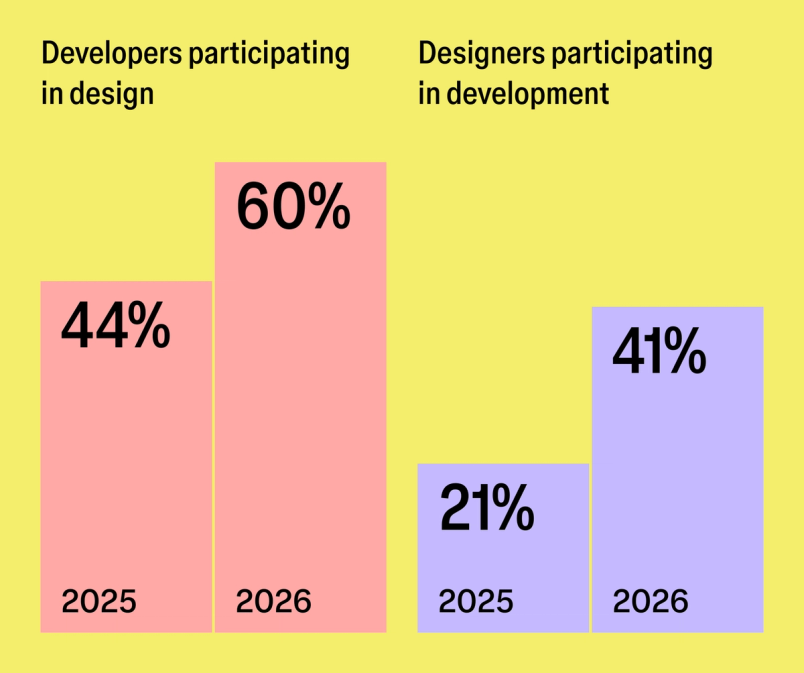
And the work itself is shifting. In the last year, the number of designers participating in development doubled to 41%, and the number of developers doing design work rose from 44% to 60%. But the bigger change isn’t what people can do—it’s where they’re doing it. Teams are turning their single-player workflows into multiplayer ones on the canvas.


of product builders say at least half their work happens on the canvas.
Today, 76% of people do at least half their work on the canvas, and six in 10 spend the bulk of their time there. Even one in five developers would rather start projects on the canvas. A terminal or a prompt is a solo space; you can't riff with someone else or put designs side by side. On the canvas, teams can explore ideas, get feedback, and work through a problem space together.
Design’s role is getting much bigger
AI can build almost anything. What it can’t do is determine what’s worth building If AI can make anyone a product builder, the real edge is knowing what’s worth shipping.

What matters when anyone can build


of respondents say design is at least as important as it was before AI.
That decision-making has always been part of design—AI has just made it more crucial. Ninety percent of respondents say design is at least as important as it was before AI, and nearly six in 10 say it’s actually more important. And that’s not just designers—65% of developers say the same. “Design, taste, and the user experience matters more than before, so we are trying to improve it every single day,” says one software engineer.

Where you go depends on where you are
The number of designers, developers, and PMs calling AI “transformational” has tripled in the past year—but that doesn’t mean they’re all using it at the same pace, or feeling the same way about it. We found four patterns of AI adoption; we’re calling them grassroots, directive, nascent, and unified.

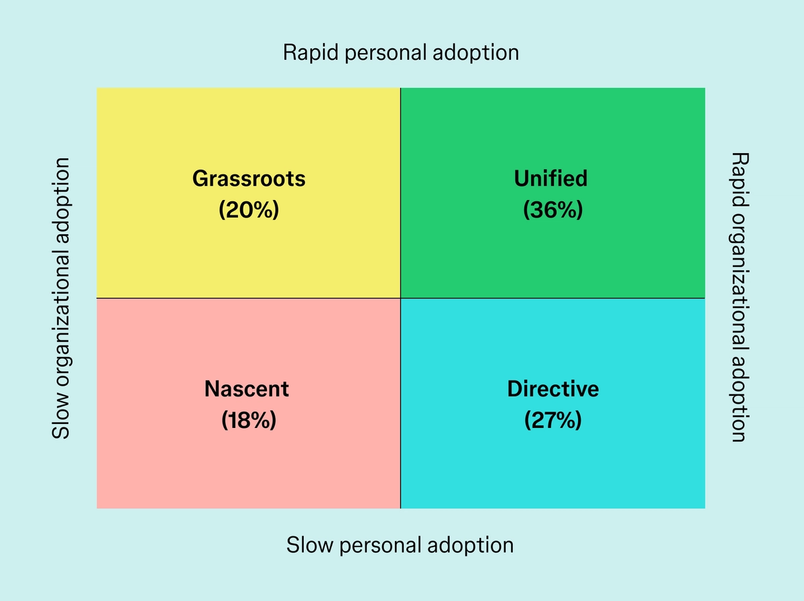
At directive companies, AI is coming from the top down. At grassroots ones, it’s bubbling up from practitioners on the ground. In both cases, there’s friction: People aren’t on the same page, and teams don’t have shared a playbook. “Ultimately it’s more of an organizational gap, exposing some of our communication and knowledge gaps across squads,” says a principal product designer at a grassroots company. The real goal is unified adoption, where individuals and organizations move AI adoption forward together.
The path forward comes down to the experience you’re having today. If you’re a grassroots changemaker, socialize what’s working—make workflows visible, build structure around them, and be a champion for shared spaces. If you’re pushing AI at a leadership level, work on closing the gap between strategy and practice.
No matter where you fall, you’re probably feeling the pressure to move faster, go further, and make better decisions. But it's not about how fast any one person moves; it's how everyone moves fast together.
To dig deeper into the new AI era, download Figma’s 2026 AI report: The new era of multiplayer design.
Madeline Stafford is a writer and editor at Figma. She was previously a content marketer at Faire, where she told stories about makers and culture. Before that, she worked in the art world.
Shane Johnston is a researcher at Figma where he explores how AI is reshaping design and product development. Previously, Shane's research focused on the future of work at Slack's Future Forum, communities at Twitter, and consumer psychology at Procter & Gamble's cognitive science group.